George Heath
|
|
||||||||||||||||||||||||
|
|
|
References
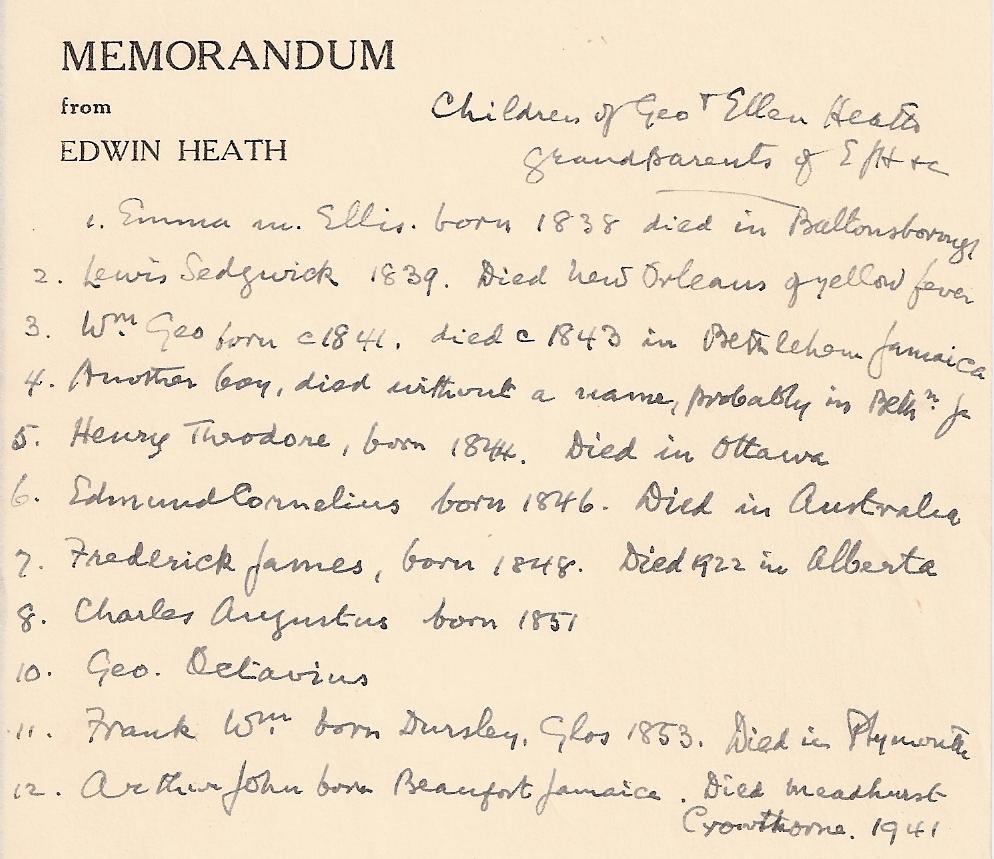
| From Edwin J. Heath
Memorandum in Bible (description of the Children of George and Ellen
Heath, his grandparents).
|
| Early Moravians in Antigua...
The Moravian presence in the West Indies was prompted by Anthony Ulrich, a slave from the Danish West Indies, who traveled in 1731 to Denmark and Germany, where he told Moravians of “the desire of blacks [in the West Indies] … for an opportunity to hear the Christian gospel” (Dayfoot 121). A year later, two members of the German Moravian colony arrived in St. Thomas. It was not until 1756, that the Moravian mission expanded to Antigua. Unlike the Moravian missionaries in the Danish islands and Jamaica, the Antigua evangelists did not support themselves by becoming planters and slave owners. “While this created [financial] hardship for the [missionary] workers themselves,” Dayfoot writes, “it relieved them of duties that were incompatible with their purpose, and it made for better relations with the slaves” (126). Moravian membership quickly multiplied at the end of the 18th century, and by 1799, it reached 11,000. Dayfoot, Arthur Charles. The Shaping of the West Indian Church: 1492-1962. Gainesville: University of Florida P, 1999. Also relative to Prince’s narrative is the Moravian requirement of personal accounts of members’ lives. “Each member of the Moravian Church was required to leave a Lebenslauf (literally, life course), a memoir or short autobiography describing a few details of the person’s outward life and an account of his or her spiritual journey. Typically the memoirs depict a sequential process leading from an unredeemed life of sin to spiritual crisis, conversion, and a new life dedicated to Christ. After the person’s death, a minister finished the memoir and read it aloud at the funeral” (Sensbach xxii). Katherine M. Faull has published the brief Lebenslauf of Magdelene Beulah Brockdon (1731-1820), who was kidnapped from the Guinea Coast as a child and sold into slavery in Philadelphia. The memoir of Magdalene’s husband, an Igbo named Ofodobendo Wooma (Andrew), appears in Daniel B. Thorp’s “Chattel with a Soul: The Autobiography of a Moravian Slave.” Another enslaved West African’s life story is preserved in the Memoir of Abraham, which was written in German by a Moravian minister in North Carolina and was “based largely on oral testimony the African Moravian had supplied before he died” (Sensbach 2). Faull, Katherine M. Moravian Women’s Memoirs: Their Related Lives, 1750-1820. Syracuse: Syracuse University P, 1997. Sensbach, Jon F. A Separate Canann: The Making of an Afro-Moravian World in North Carolina, 1763-1840. Chapel Hill: University of North Carolina P, 1998. History Moravian traces its origin to a girls' school founded in May 1742 by sixteen-year-old Countess Benigna von Zinzendorf. The young countess, on an eighteen-month visit to the Moravian settlements in the New World with her father, Count Nicholas von Zinzendorf, was following a Moravian tradition that was already old in her time. The roots of the Moravian denomination go back to the Bohemian Protestant martyr John Hus, who died at the stake in 1415. In 1457 the denomination was formally organized under the name Unitas Fratrum, "the Unity of the Brethren." The Brethren (later called the Moravians in the New World) gave to the world the pioneer educator John Amos Comenius (1592-1670), who was one of their bishops. Called "the father of modern education" for his revolutionary educational principles, Comenius was a man of his time in thinking of education in religious terms. He viewed education as an instrument of salvation (because the soul had to be trained to search for truth and to recognize it when it was found). Since the Moravians considered every human soul a potential candidate for salvation, every human being had to be educated. Comenius wrote in 1632 that "not the children of the rich or of the powerful only, but of all alike, boys and girls, both noble and ignoble, rich and poor, in all cities and towns, villages and hamlets, should be sent to school." The Moravians therefore considered schools secondary in importance only to churches. Following a period of intense persecution, during which the struggling church was threatened with extinction, the Brethren in 1722 were given asylum on the Saxony estate of an ecumenical-minded Lutheran nobleman, Count Nicholas von Zinzendorf, who became their leader as well as their benefactor. In 1732 settlers from Germany and Moravia (now part of the Czech Republic) came to the New World. On Christmas Eve 1741 they founded the community of Bethlehem in what was then wilderness, sixty miles north of Philadelphia. Count Nicholas and his daughter were there for the occasion. Benigna von Zinzendorf's school was the first girls' boarding school in America. It gained such a distinguished reputation that George Washington, during his second term as president of the United States, personally petitioned the headmaster for the admission of two of his great-nieces. The Bethlehem Female Seminary, as the school became known, was chartered to grant baccalaureate degrees in 1863, and in 1913 became Moravian Seminary and College for Women. A boys' school was established in Bethlehem in July 1742, and another in nearby Nazareth in 1743. These schools merged in 1759 to form Nazareth Hall, an institution which survived until 1929. In 1807 a men's college and theological seminary was established as an extension of Nazareth Hall. That institution, Moravian College and Theological Seminary, moved to Bethlehem in 1858 and was chartered to grant baccalaureate degrees in 1863, the same year as the women's college. In 1954, after two centuries of separate development and growth, the women's and the men's institutions were combined to form a single coeducational college. Moravian Theological Seminary maintained a closely related but academically distinct identity as a graduate school of theology. As a result of the merger, Moravian College became the Lehigh Valley's first coeducational institution of higher education. |