George Reinke Heath
|
Uncle George, however, was a genius and linguist, spoke 12 languages, gave the Miskito Indians their first written grammar, also had gone to medical school in Heidelberg, Germany and knew lots of cures.
|
||||||
|
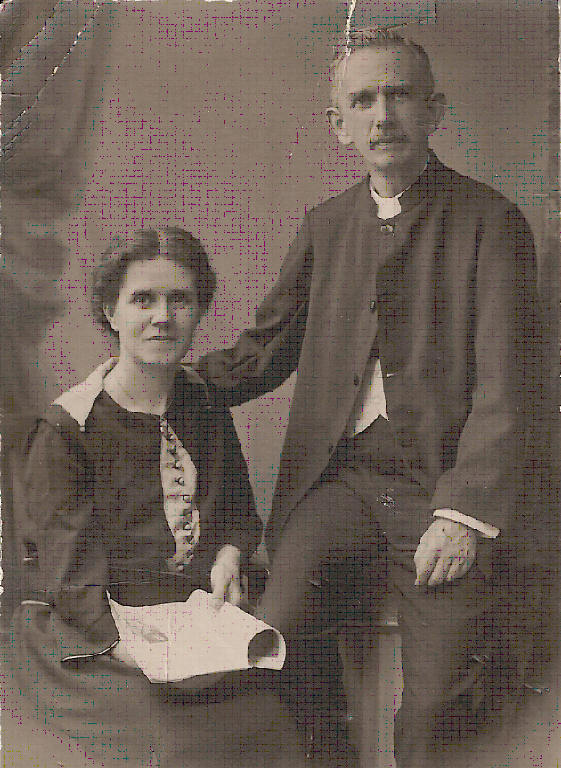
George Reinke Heath and Marguerite Heath, taken June 1922, England. |
|||||||
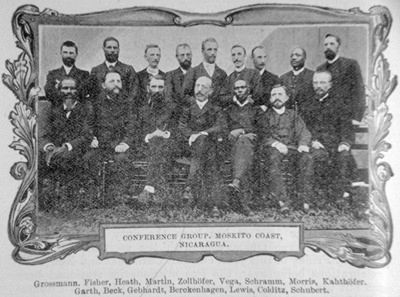 Conference Group, Moskito Coast, Nicaragua. Undated.
|
References
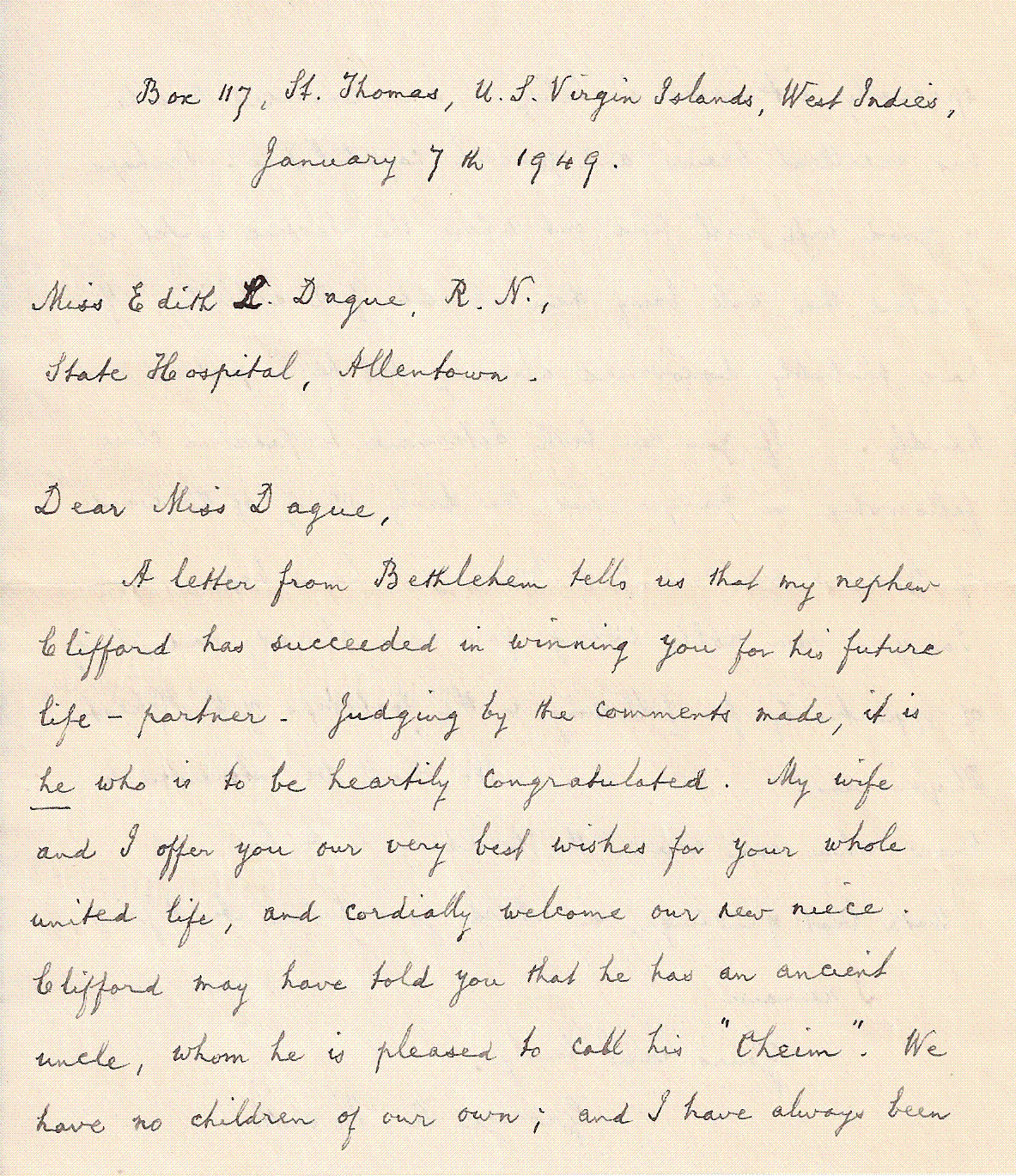
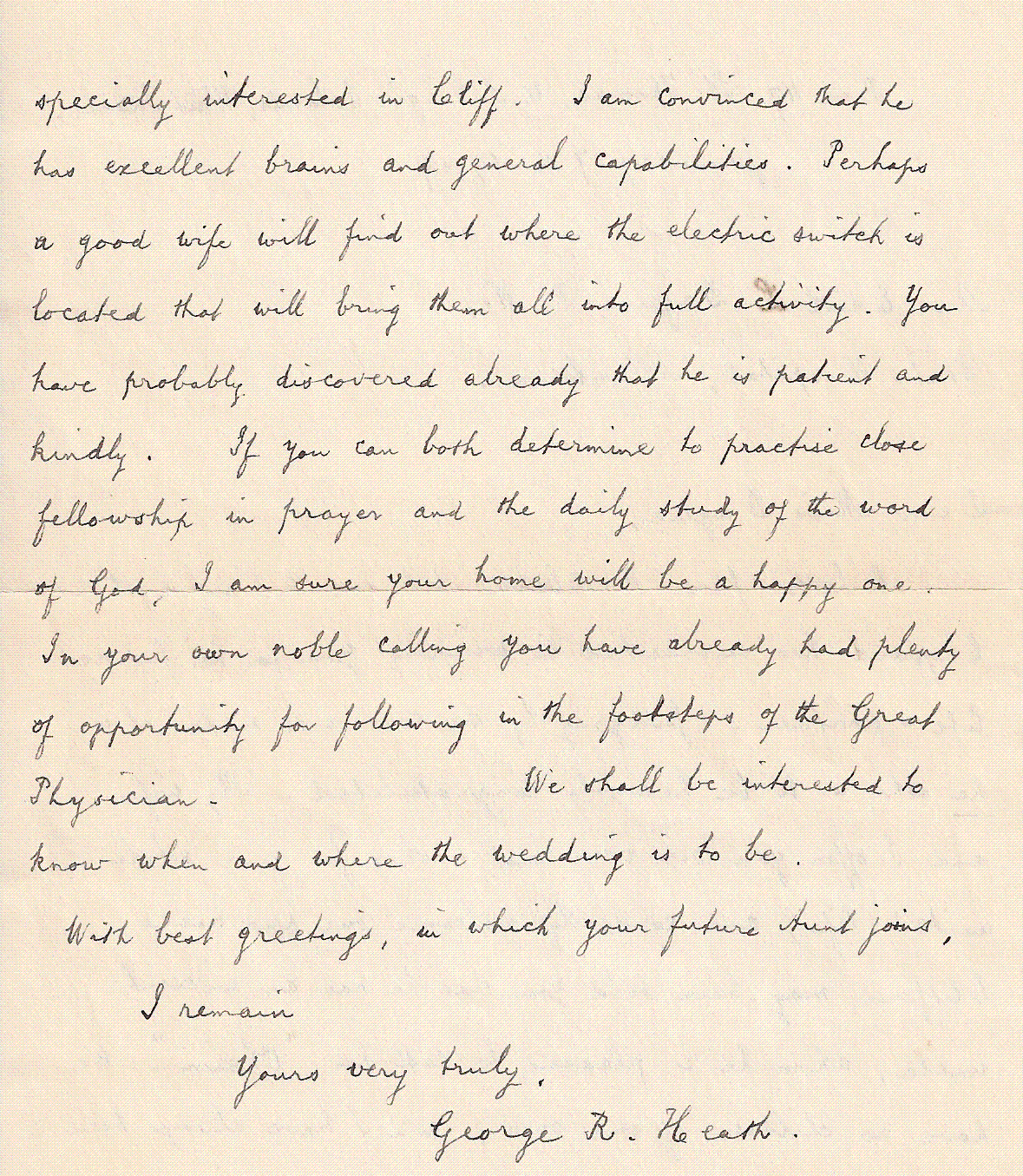
| Letter to Miss Dague (future Mrs. Edwin Clifford Heath) on the occasion of her engagement - Box 117, St. Thomas, U.S. Virgin Islands, West Indies, January 7th, 1949. Miss Edith L. Dague. R.N. State Hospital, Allentown. Dear Miss Dague : A letter from Bethlehem tells us that my nephew Clifford has succeeded in winning you for his future life-partner. Judging by the comments made, it is he who is to be heartily congratulated. My wife and I offer you our very best wishes for your whole united life, and cordially welcome our new niece. Clifford may have told you that he has an ancient uncle, whom he is pleased to call his "Chum". We have no children of our own; and I have always been specially interested in Clifford. I am convince that he has excellent brains and general capabilities. Perhaps a good wife will find out where the electric switch is located that will bring them all into full activity. You have probably discovered already that he is patient and kindly. If you can both determine to practice close fellowship in prayer and the daily study of the word of God, then I am sure your home will be a happy one. In your own noble calling you have already had plenty of opportunity for following in the footsteps of the Great Physician. We shall be interested to know when and where the wedding is to be. With best greetings, in which your future Aunt joins, I remain Yours Very Truly, George R. Heath. | ||||||||||||||||||||||||||||||||||||||||||||||||||
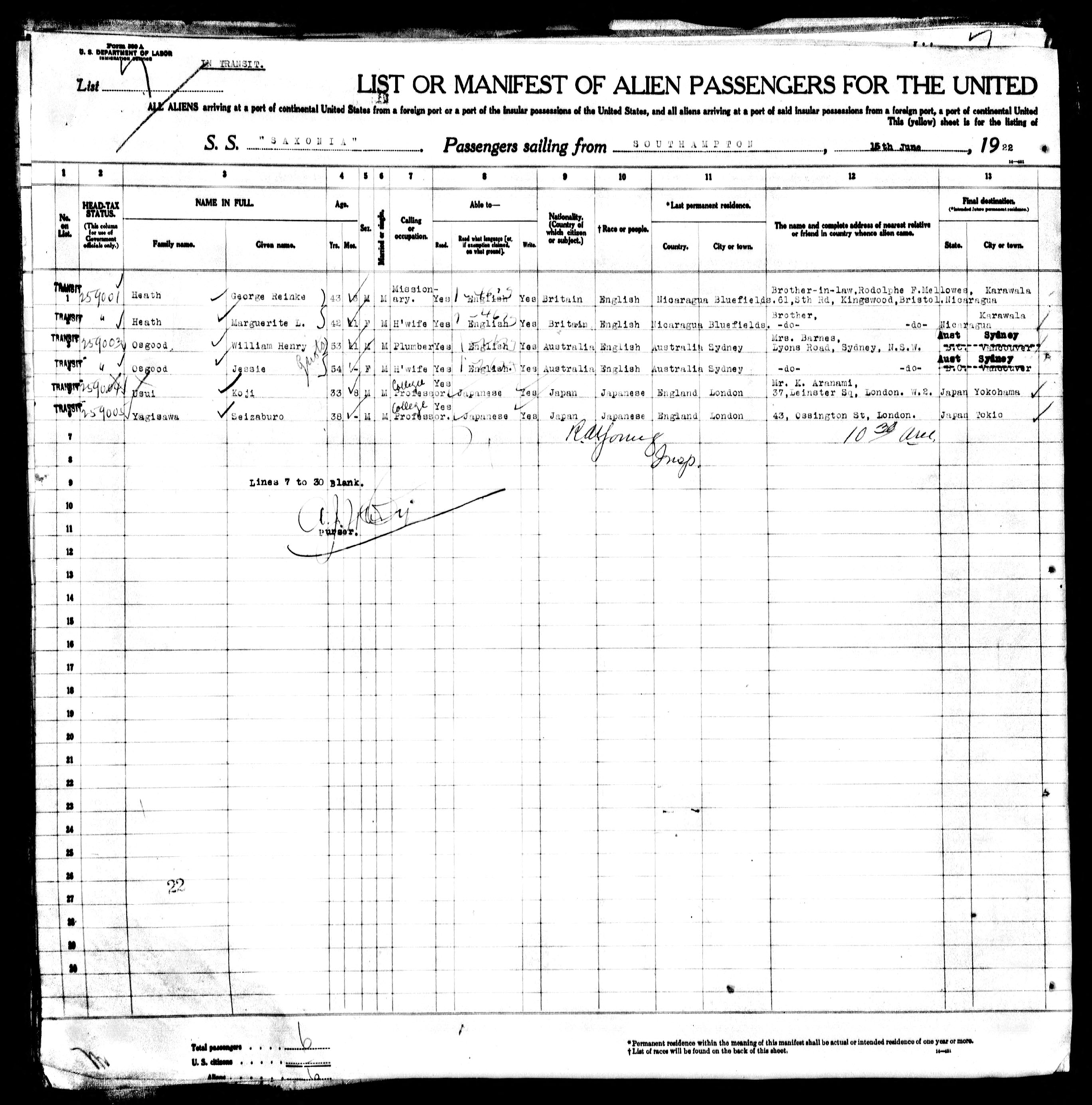
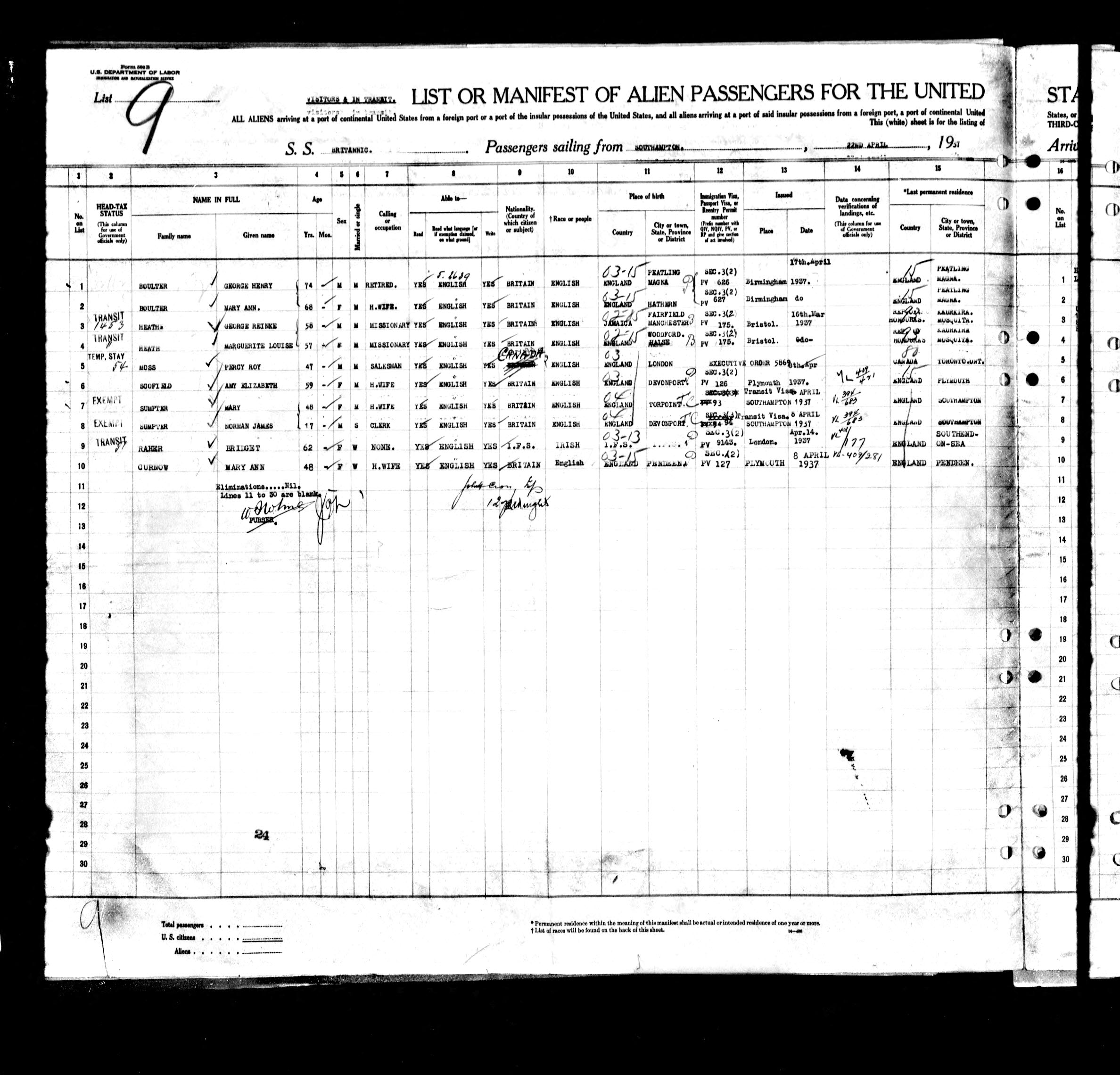
| Arrival Records:
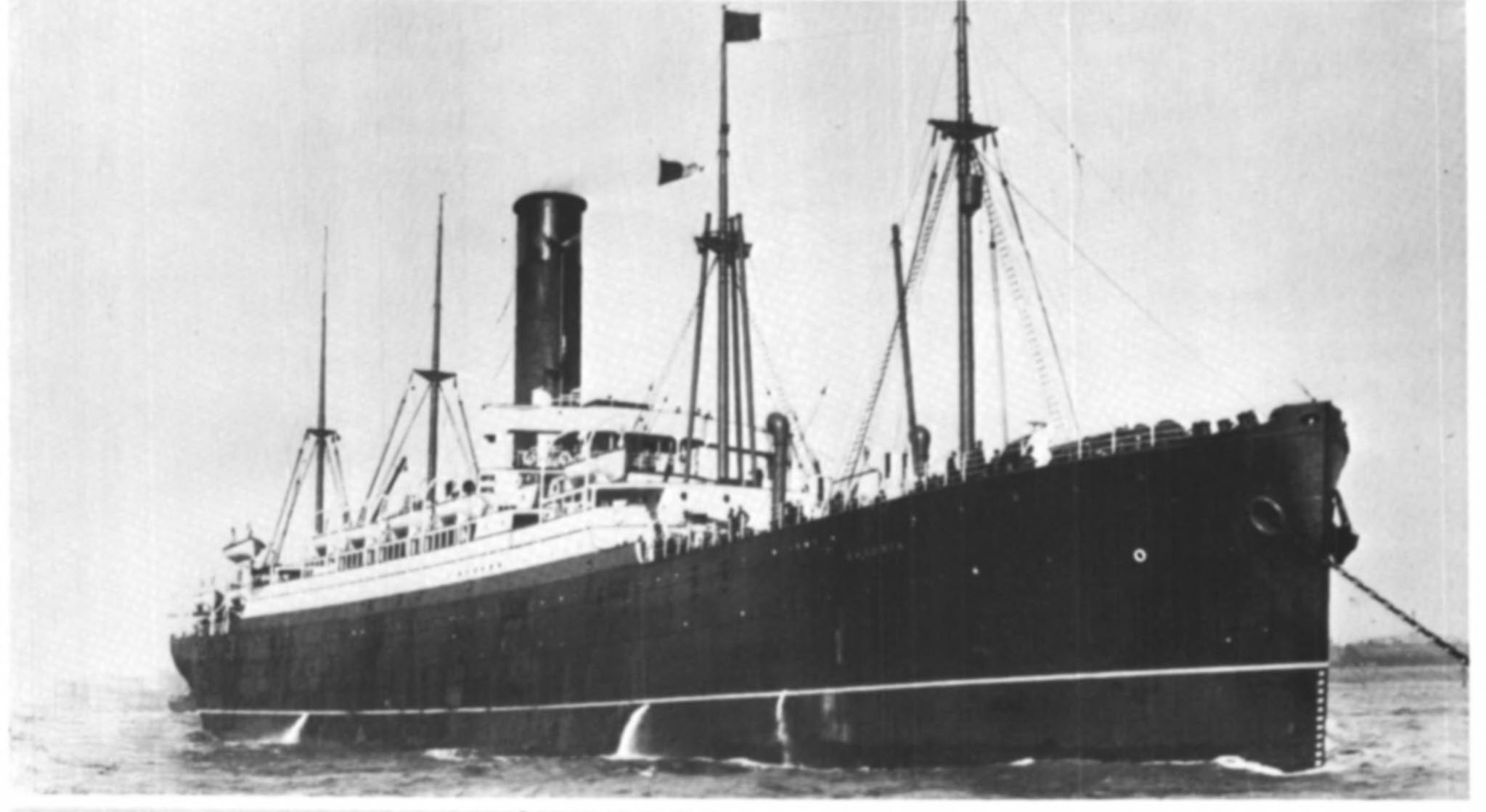
Arrived 26 Jun 1922, from Southampton, England to NYC Ship Name: Saxonia Years in service: 1900-1926 Funnels: 1 Masts: 4 Ship Description: Builder: John Brown and Company, Clydebank, Glasgow, Scotland. Tonnage: 14,197. Dimensions: 580' x 64' (600' overall length). Twin-screw, 16 knots. Quadruple expansion engines. Four masts, one funnel. Shipping Line: Cunard Arrived 30 Apr 1937, From Southampton, England to NYC Ship Name:
|
||||||||||||||||||||||||||||||||||||||||||||||||||
Census Record :
http://www.calverley.info/cen_pud_1891_ed14.htm
|
||||||||||||||||||||||||||||||||||||||||||||||||||
| The following are memories from Marion Graham Heath Hooper, daughter of Edwin Joseph Heath, recorded October 13, 2006 : Edwin Joseph Heath was born on December 27, 1880 in St. John, US Virgin Islands, where his parents, Charlotte Reinke Heath and George Octavius Heath, were missionaries. At the time the Virgin Islands were still Danish. Charlotte Amalie (pronounced Uh-MAL-yuh) the capital of USVI, was named after the Queen of Denmark. George Octavius was so called because he was the eighth child of.....?? Whoever they were. He was one of six living children who grew to adulthood. It is said that Charlotte Heath had 12 babies, including twins, but only six survived early childhood. Edwin's five siblings were: George Reinke Heath, (oldest) Mary Heath Fraser (married James Fraser), Herbert Heath, (moved to Canada, married his cousin Blanche, had 4 children) and Harold Heath (married Janet?, became an actor, entertainer, and magician. He was a one-man band, FAR more interesting than the others. Uncle George, however, was a genius and linguist, spoke 12 languages, gave the Miskito Indians their first written grammar, also had gone to medical school in Heidelberg, Germany and knew lots of cures. Charlotte had been an American. The Reinkes came to the US from Sweden in the 17th century and she had an ancestor who had been a circuit riding preacher in Swedesboro, NJ in 1696. I'm not sure if she was a Moravian. My grandfather George O. Heath was a handsome, blue eyed, white haired guy in his photograph taken around 1920 or so. Grandma Charlotte was somewhat more severe. George's family as I understand it, were from somewhere in the midlands of England. George and Charlotte sent all their children except baby Harold to school in England, as was the custom with colonials living abroad. The missionary parents traveled around 'mishing" all over the Caribbean. My dad considered Jamaica "his" island. Some of his siblings were born there. The Heath children went to Fulneck School,, a Moravian school in Fulneck, near Leeds, in England. Judging from reports, it was a horrible place, very strict, very Dickensian. Evidently those old German Moravians had missionaried themselves over to England and converted some English families, probably in the 18th or early 19th century, so there are English Moravians, and this Heath family were some of them. After finishing Fulneck, Edwin, my dad, went to London to work for a time for the British and Foreign Bible Society. While in London he went to music halls and learned some funny patter songs, which he used to sing. He also attended the Diamond Jubilee of Queen Victoria, whenever what was, let's see, 1837 plus 60, it was in 1897. He attended it as a person standing in the street waving a flag, not at Buckingham Palace. His older brother George had gone, it is said, to Heidelberg in Germany to study medicine, but contracted tuberculosis and had to drop out, and while recovering he changed his mind and went to theological seminary in Bethlehem. Edwin followed, and graduated from Moravian College for Men in 1904. He went on to get a B.D, degree from Moravian Theological Seminary, was ordained and became a missionary, I think the boys' dad, George O, had also gone there for his degree, while there, he met this American girl he married that would be Charlotte. Some additional memories from Marian, 17 Dec 2006: My Uncle George's wife name was Marguerite. She was from Yorkshire. We called her Auntie Maggie. That's a nice picture of them you sent. George was the only genius the family has ever had as far as I know. He really was a genius. Spoke 12 languages and gave the Miskito Indians in Nicaragua? Honduras? their first written language. He determined what their language was from listening to them, and he translated the whole Bible into Miskito. It must have been pretty funny as he was stone deaf and had a really bad ear for sounds. he had a fabulous brain but no ear. He spoke Spanish perfectly but with a terrible English accent. He also knew Latin, Hebrew, Greek, Aramaic, German, French, etc. etc. He had studied medicine but got tuberculosis and dropped out of medical school in Heidelberg, Germany, but later on he practiced medicine among the Indians anyway, and knew a lot of interesting stuff about herbal cures and the fact that fluoride helps keep teeth strong, WAY back before it became popular knowledge. He said the Indians got their fluoride from charred animal bones. He was known as the "walking encyclopedia." He had an incredible amount of knowledge about everything. |
||||||||||||||||||||||||||||||||||||||||||||||||||
|
http://lcweb2.loc.gov/cgi-bin/query/r?frd/cstdy:@field(DOCID+ni0040) The Moravian Church, established in eastern Nicaragua in the late nineteenth century, is the dominant faith among the non- Hispanic population of the region. Virtually all Miskito are Moravians, as are many Creoles, Sumu, and Rama. Moravian pastors play a prominent leadership role in Miskito communities. The Nicaraguan Baptists are related to the American Baptist Church, which began missionary work in 1917. The Nicaraguan Baptist Church's membership is concentrated in the Pacific region and is heavily middle class. |
||||||||||||||||||||||||||||||||||||||||||||||||||
|
http://links.jstor.org/sici?sici=0020-7071(195001)16%3A1%3C20%3AMGWEC%3E2.0.CO%3B2-2 1.0 From the Reverend G. R. Heath's Miskito Lexicon, completed in 1947 in 510 manuscript pages, we have extracted terms of flora and fauna, including many medicinal terms, especially of plants used for curing; items from MIskito folklore and social organization, and some other terms. Some entries are little essays, as that under pa*sa which distinguishes between cardinal directions oriented by heavenly bodies and cardinal directions otherwise oriented; so also, under ka*ti; the Miskito calendrical system is given; compare also the entries pyu*ta saika and miskito. Other entries are briefer but are, in all cases, selected because they include ethnographic commentary. The remaining entries included in Heath's manuscript (but not in this paper) consist mainly of a Miskito-English glossary, without ethnographic comment. |
||||||||||||||||||||||||||||||||||||||||||||||||||
| Writings by G. R. Heath: Heath, George Reinke (1913) "Notes on Miskito Grammar and other Indian Languages of Eastern Nicaragua," American Anthropologist 15, 48-62. Heath, George Reinke (1924) "Industrial Needs in Nicaragua," in Proceedings of the Society for Propagating the Gospel, 84-86. Heath, George Reinke (1927) Grammar of the Miskito Language, Lindenbein, Herrnhut. Heath, George Reinke (n.d.) "Outlines of Sumu Grammar," ms. Heath, George Reinke (?) early article in International Journal of American Linguistics about plants etc. Heath, George Reinke (1950) "Miskito Glossary, with Ethnographic Commentary," International Journal of American Linguistics. Heath, George Reinke and W. G. Marx (1961) Diccionario Miskito-Español, Español-Miskito, Imprenta Calderón, Tegucigalpa. Heath, George Reinke and W. G. Marx (1983) Diccionario Miskito-Español, Español-Miskito, Editorial Hunter Publishing Co., Winston-Salem. |
||||||||||||||||||||||||||||||||||||||||||||||||||
| Letter from Hilton - November 21st, 1993, Wahamlaya, Nicaragua -- describing his visit with Heath while on foot in Nicaragua -- To clear up a few points while they are fresh on my mind - On my arrival in Caukera - a small Indian village of four houses, I learned that a mile further along the trail was located the home and church of a Moravian Missionary by the name of Mr. Heath. This gentleman I learned had pioneered in missionary work among the Meskito Indians of the area for the last 30 years. He has translated the New Testament to the language of the Meskitos - his has been a real studious effort toward teaching these primitive people the civilized faith and ways of the white man. He is known all thru the Lgaon sections of Nicaragua as well as far into the interior. I wanted to meet this man - to see and draw my own conclusions as to what manner of man he could be. Anyone that could possibly interest themselves n the welfware of such as squalid and primitive race, in such impossible living conditions was of interest to me, and too, I've read at times varying articles on the merit of missionary work among savages, but never did I have the opportunity until now to see at first had the activity of the actual field work. Due to a hard storm I was unable to visit him on the day I rested at Caukera - but the following day about 8:30, I came out of the jungle country into the clearing of his compound just a s suddenly as that. here was located a bamboo and thatch church, his home and out buildings, and being Sunday there was groups of Indians waiting of services at 9:00 am. The home of Mr. Heath was a small well built cottage which showed at a glance the decorative hand of a good house wife. Curtains were draped in teh windows and flowers and ferns were set out around the porch. Indeed a great sight to one who has been living in mud and thatch houses for weeks. I introduced myself to Mr. Heath and in turn was introduced to his wife - both received me warmly and sincerely and begged me to rest a day and night with them, but I had three Indians waiting on the train for me who I wished to use as guides and I disliked their services, so I declined. Instead I had a short visit with them and was impressed with the keen sincerity of their work. Mr. and Mrs. Heath are aging people, both are white haired and kindly folk. Both are keen students of their work and it would be hard to find two people better fitted for the tedious effort that is theirs. In a motherly way, Mrs. Heath insisted that I take a lunch to carry with me on the 21 mile walk to Curta and she busied herself in its preparation. The while I visited with Mr. Heath. Too bad indeed that my stay was so short as I found him wonderfully interesting. Naturally his very life is centered in his work and our talk concerns the accomplishments of his efforts. He requested that I visit the Mission at Wahamlaya where I would meet an American lady that he referred to as our nurse. I promised that I would, and here we are now at th esmall thatch rooted home of Miss. Kreitlow, where I've again been warmly treated. Miss Kreitlow has had over eight years among these Indians. She has mastered their language and helped translate Christian songs into Meskito. Here too, is a sincere, studious woman, patient towards her work. Daily she has school classes, church services, and domestic science in sewing for the younger Indian girls.... |