Edwin Joseph Heath
|
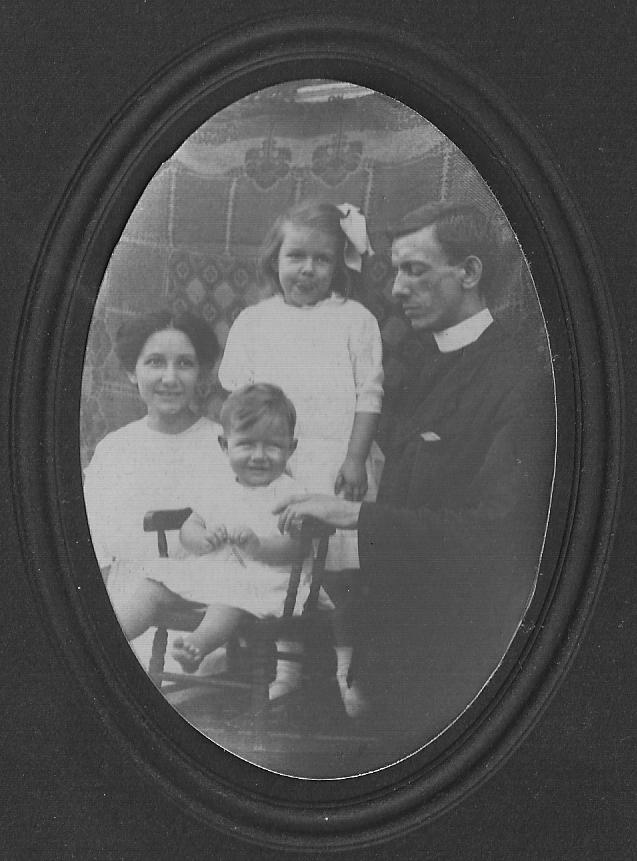 Taken in Antigua, Ludious 1914. Mabel, Cliff (baby), Barbara (young girl), and Edwin Heath Sr.
|
||||||||
|
Edwin J. Heath was a Moravian Missionary in Antigua, when he married Mabel Mary Graham. He went on to become Dean of the Moravian Woman's college in Bethlehem, PA. Some documents of the time mention his "striking resemblance to Woodrow Wilson". |
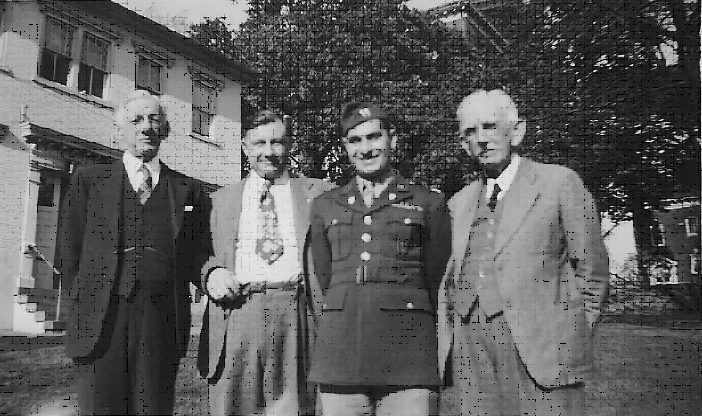
April 1946. Edwin J. Heath, Edwin Clifford Heath, Unknown, Unknown.
|
||||||||
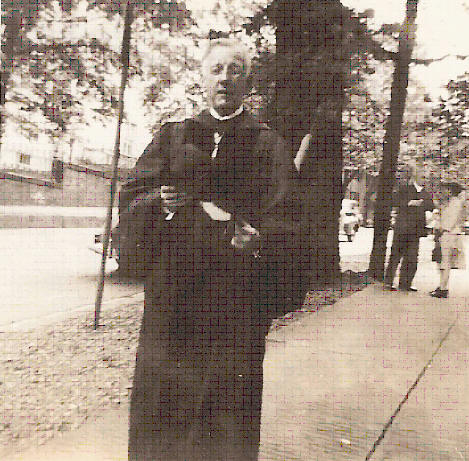 Dr. Edwin J. Heath - Undated Photograph
|
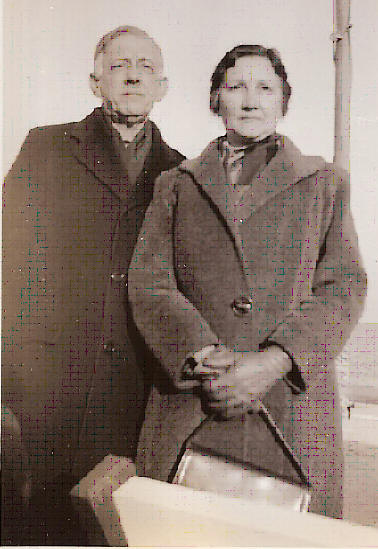 Edwin J. Heath and Mabel Mary Graham Heath - Undated Photograph |
||||||||
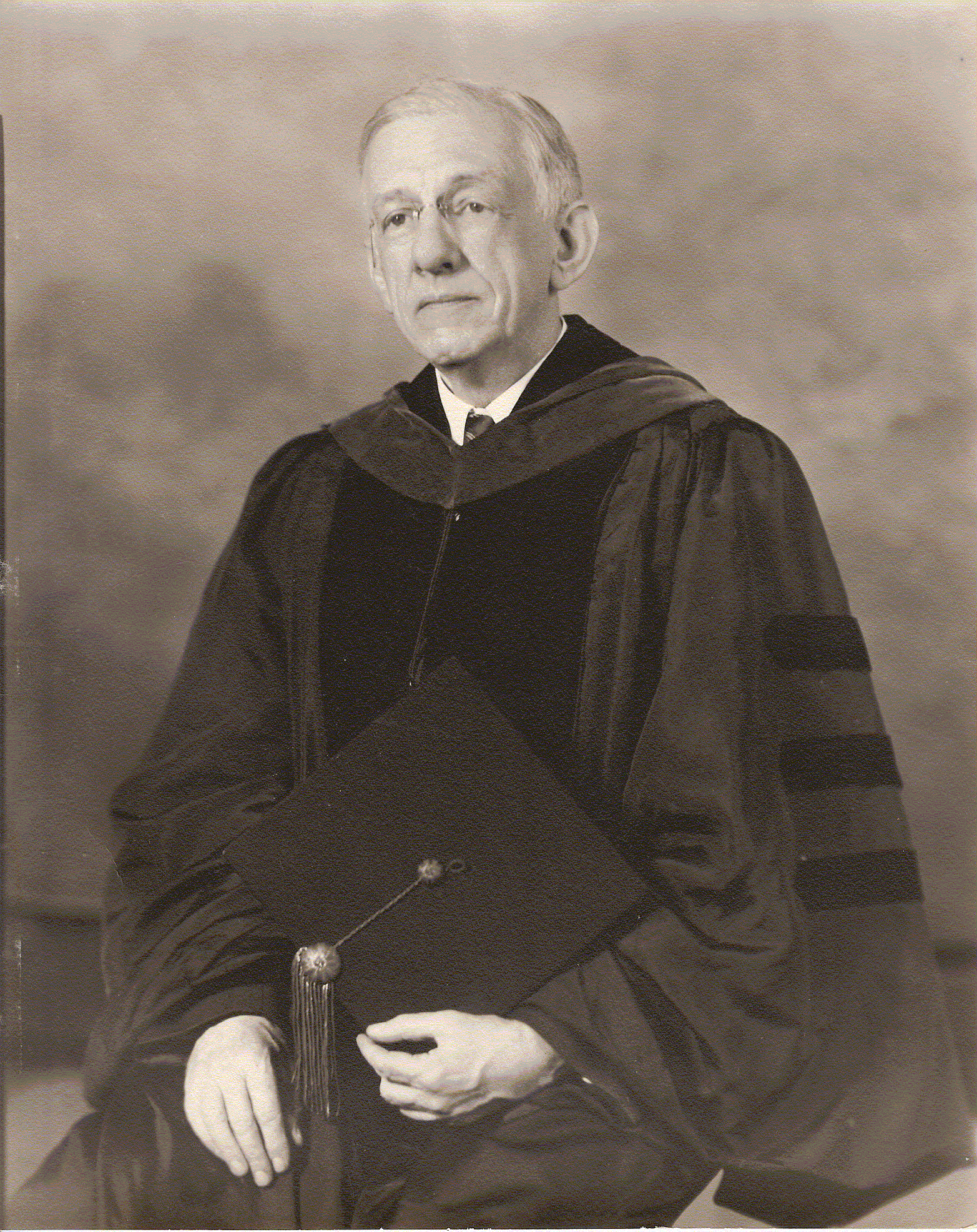 Dr. Edwin J Heath - President of Moravian College for Women, about 1950
|
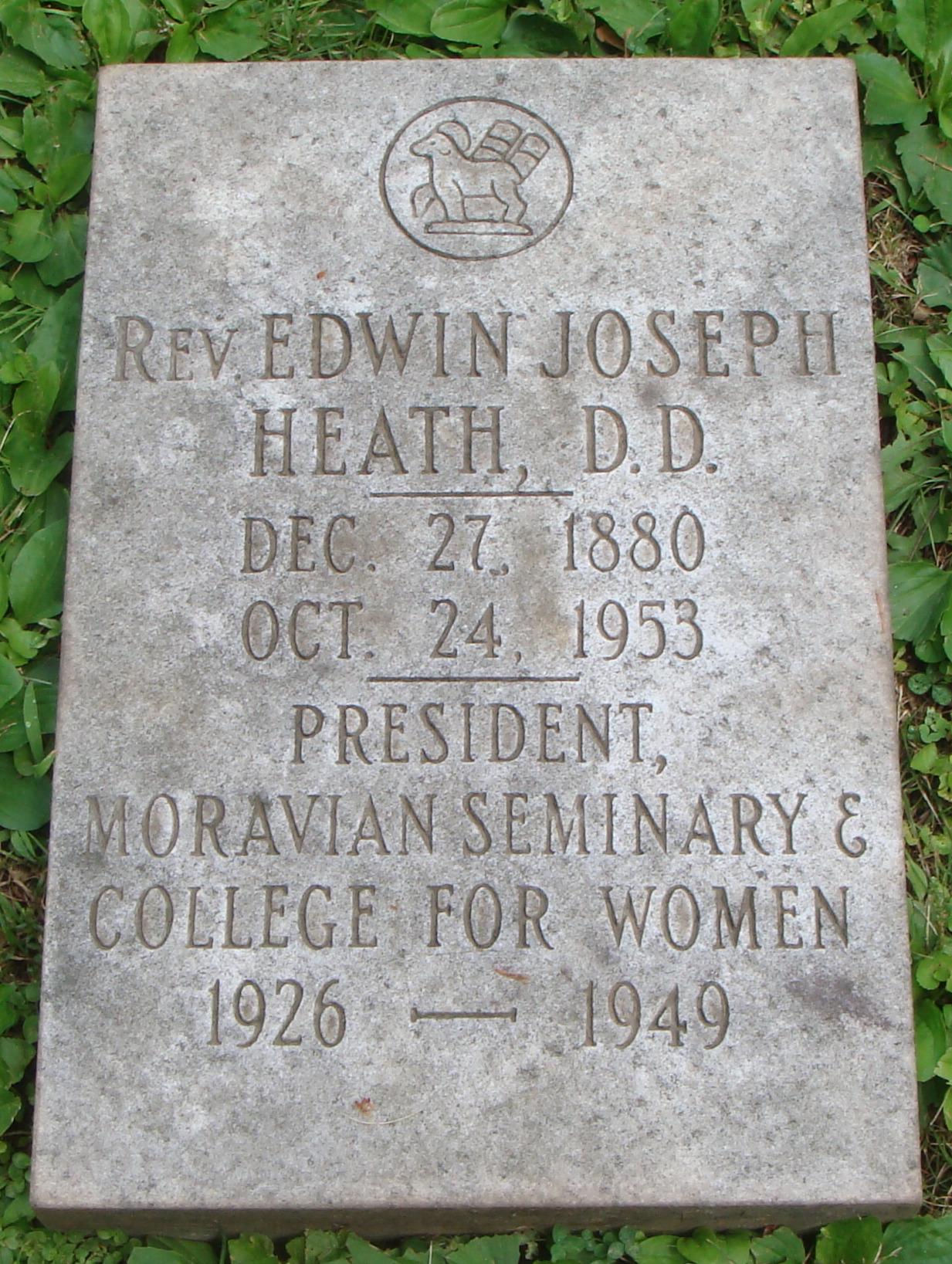 Nisky Cemetery, Bethlehem, PA |
References
| Dr. Edwin J Heath -
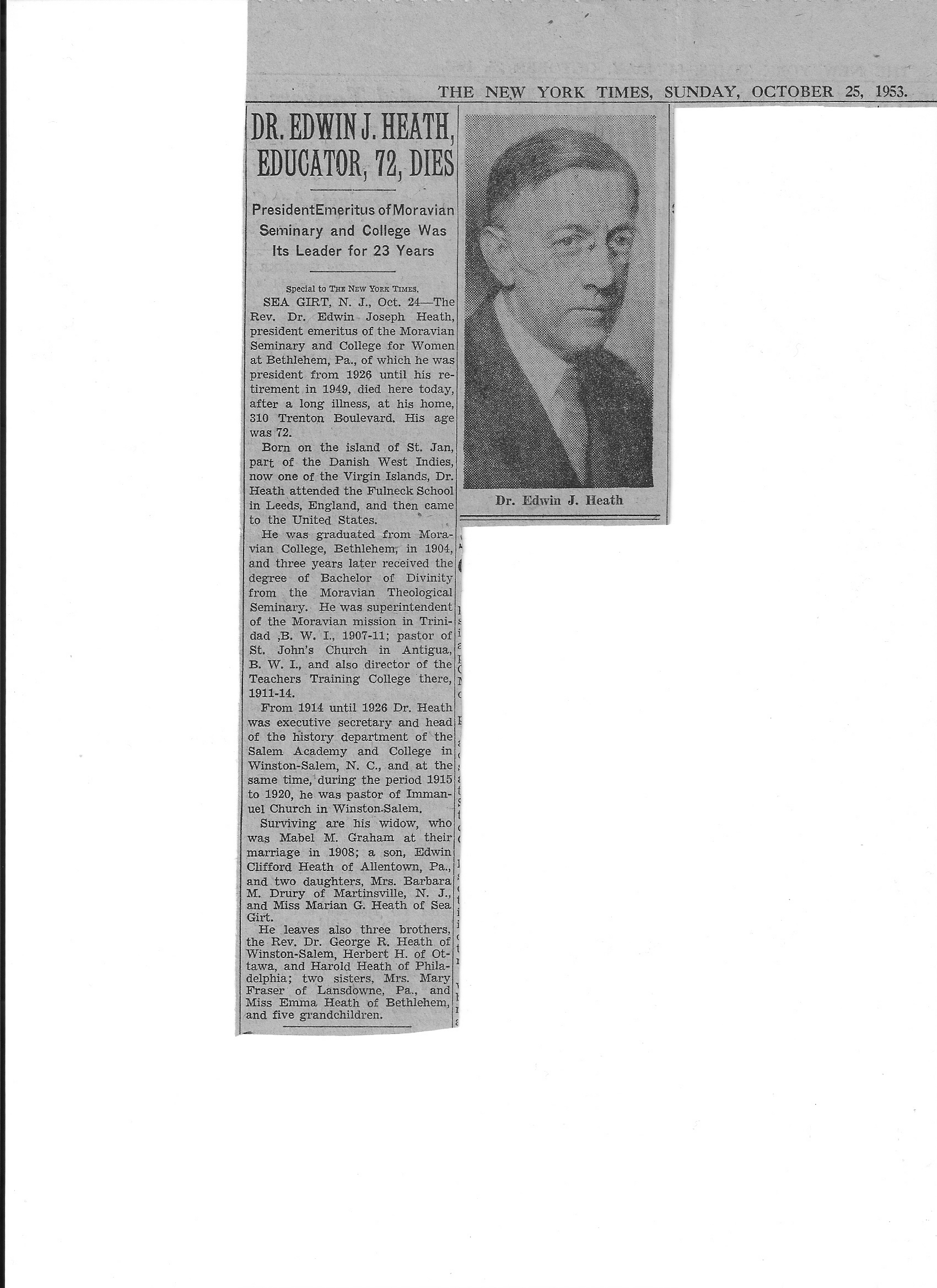
Obituary - The New York Times October 25, 1953.
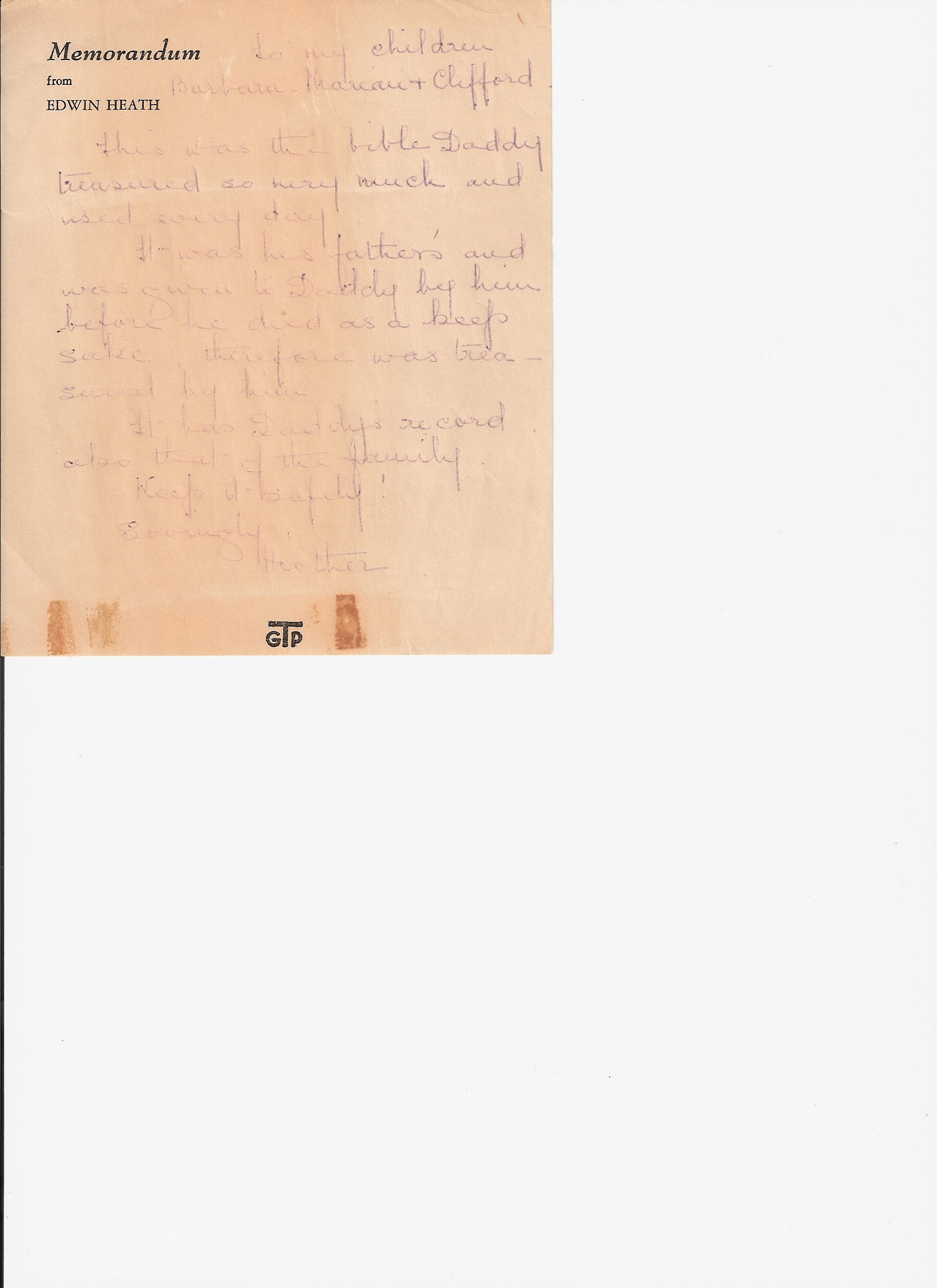
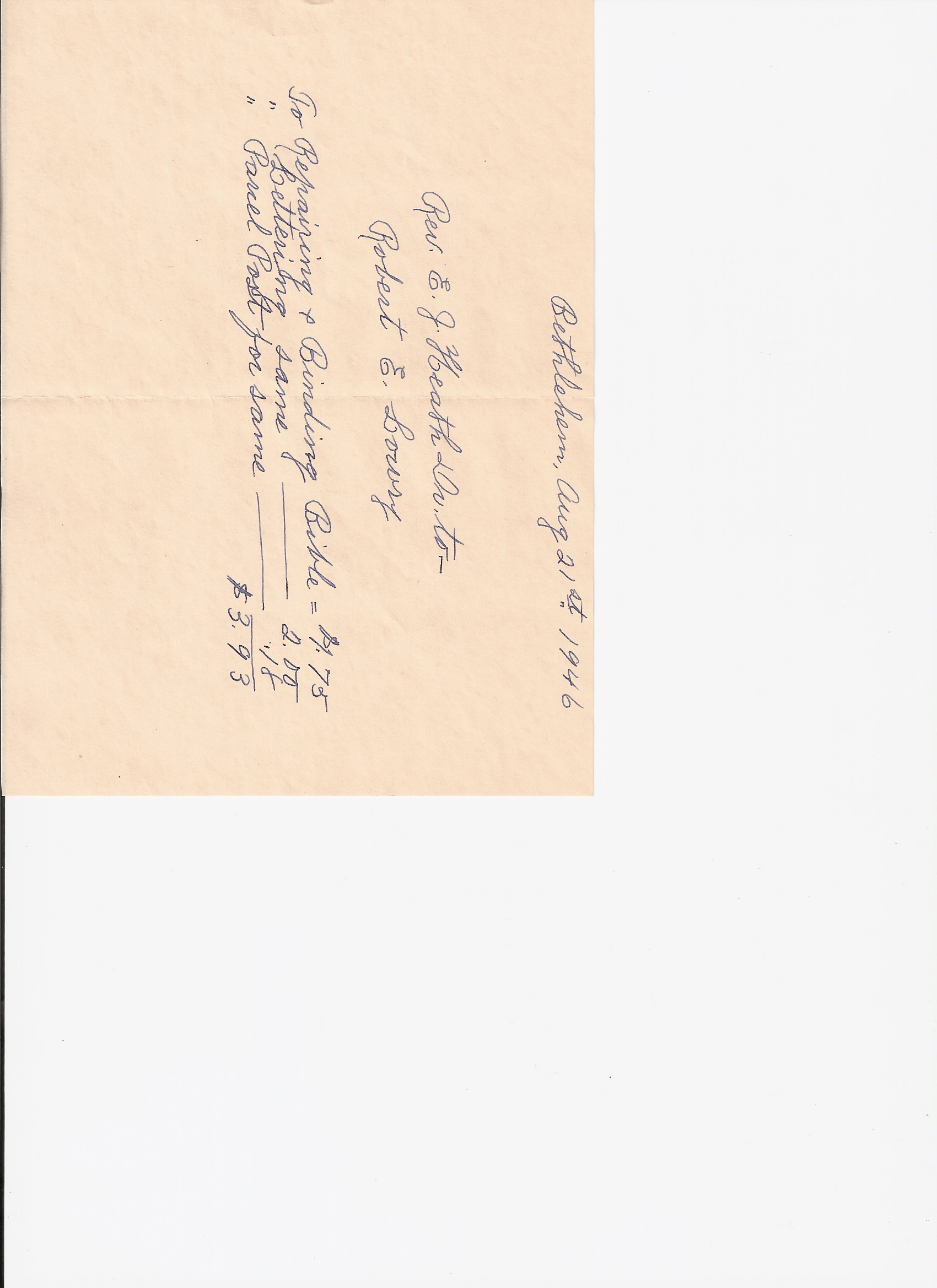
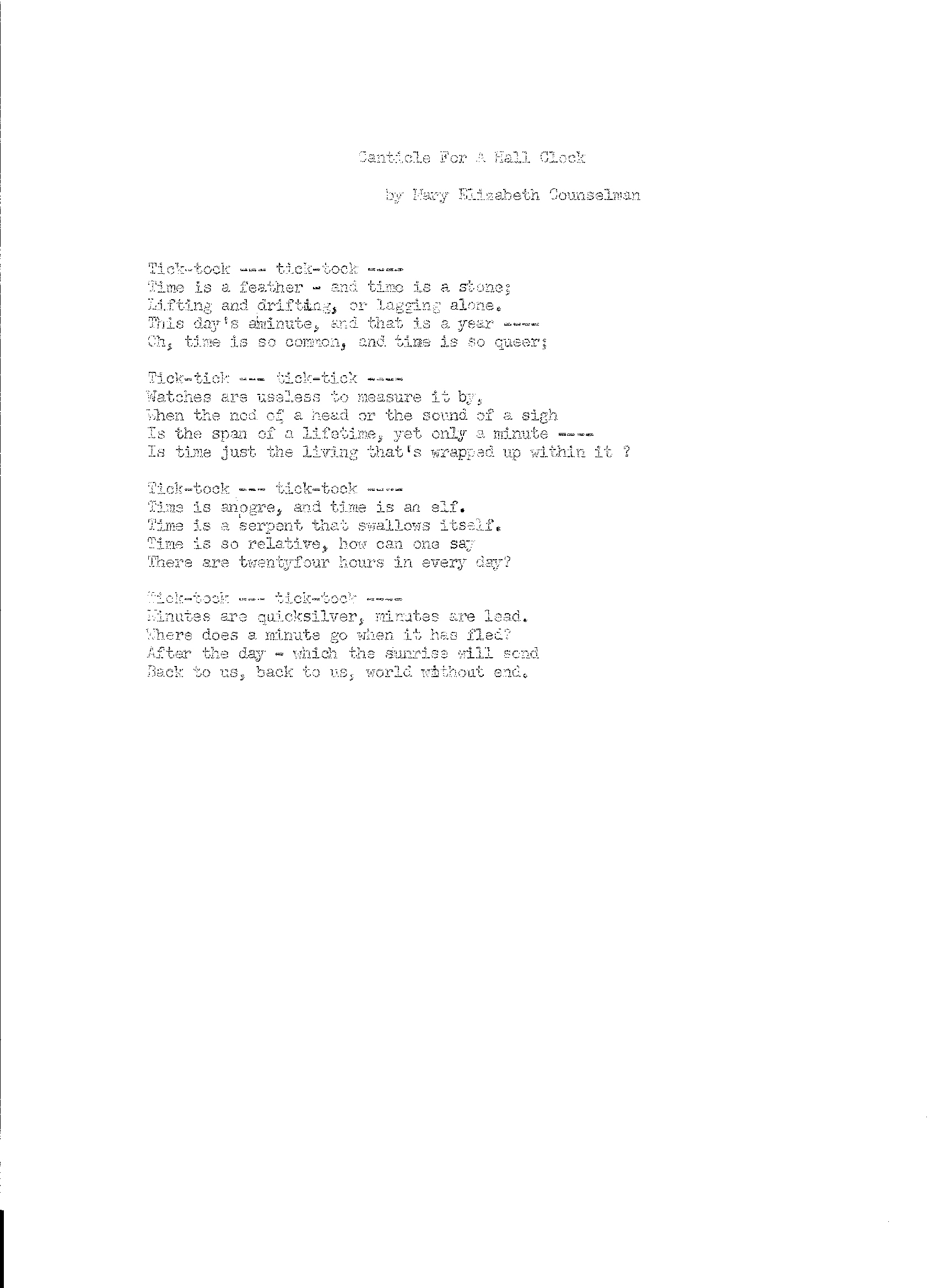
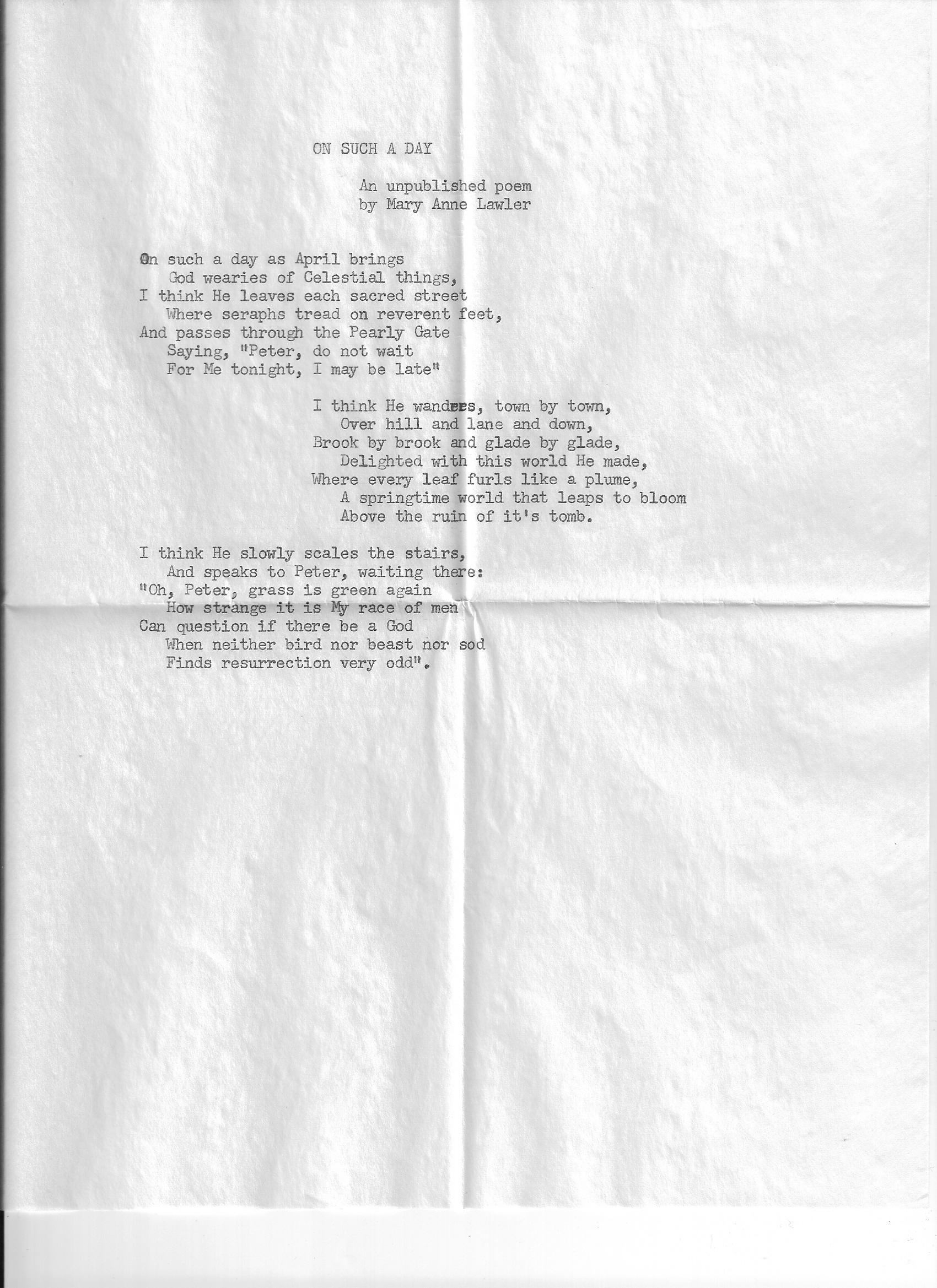
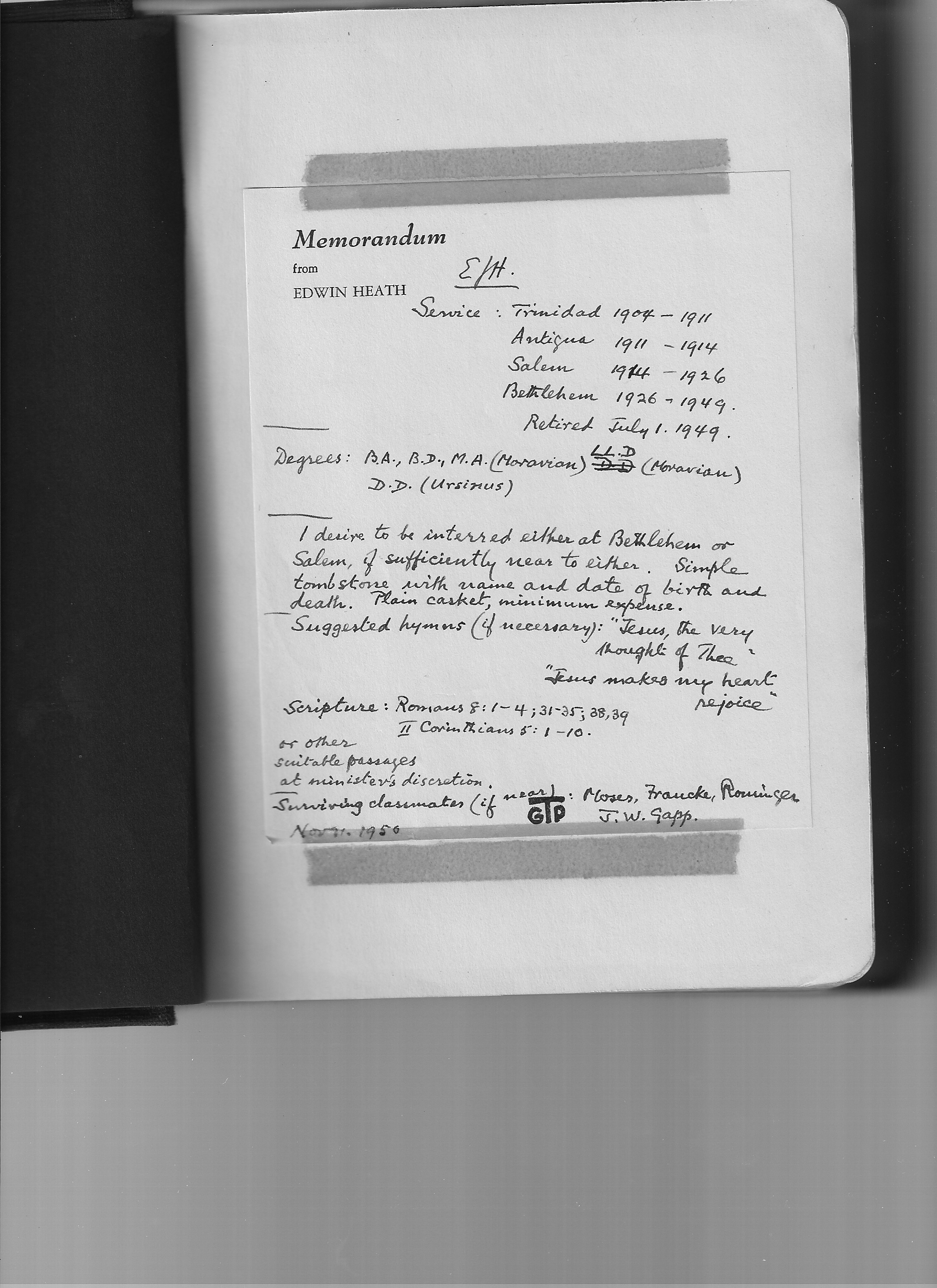
To my children, Barbara, Marian, and Clifford. This was the bible Daddy treasured so very much, and used every day. It was his fathers and was given to Daddy by him before he died as a keepsake, therefore was treasured by him. It was Daddy's record of the family. Keep it safely. Lovingly, Mother. Receipt found in Edwin J Heath Bible regarding the rebinding of the Bible (this solved the mystery of why the outside of the bible said Edwin J. Heath; rather than George O. Heath, as George O. Heath was the original owner. - Bethlehem, Aug 21st, 1946. Rev. E.J. Heath, Dr. to Robert E. Lowry. To repairing and binding bible = $1.75. To Lettering of the same = $2.00. To Parcel Post for same = $.18. Total: $3.93. Poem found in letter inscribed to Doctor Edwin Heath (addressed) by Mary Elizabeth Counselman, Canticle for a Hall Clock. Tick-tock --- Tick-tock -- Time is a feather - and time is a stone, Lifting and drifting, or lagging alone. This day's a minute, and that is a year -- Oh, time is so common, and time is so queer. Tick-tick --- tick-tick -- Watches are so useless to measure it by. When the nod of a head or the sound of a sigh. Is the span of a lifetime, or only a minute -- Is time just the living that's wrapped up within it? Tick-tock --- tick-tock --- Time is an ogre, and time is an elf. Time is a serpent that swallows itself. Time is so relative, how can one say. There are twenty four hours in every day? Tick-tock --- tick-tock --- Minutes are quicksilver, minutes are lead. Where does a minute go when it has fled? After the day - which the sunrise will send, Back to us, back to us, world without end. Poem found in letter transcribed to Doctor Edwin Heath (addressed) by Mary Anne Lawler, "An Unpublished Poem", ON SUCH A DAY. On such a day as April brings, God wearies of Celestial things, I think He leaves each sacred street, Where seraphs tread on reverend feet, And passed through the Pearly Gate, Saying "Peter, do not wait For Me tonight, I may be late". I think He wanders town by town, Over hill and lane and down, Brook by brook and glade by glade, Delighted with this world He made, Where every leaf furls like a plume, A springtime world that leaps to bloom, Above the ruin of it's tomb. I think He slowly scales the stairs, And speaks to Peter, waiting there; "Oh, Peter, grass is green again, How strange it is My race of men; Can question if there is a God, When neither bird nor beast sod; Finds resurrection very odd". Insert from Edwin J Heath Bible dated Nov 21, 1950 : Memorandum from EDWIN HEATH (EJH), Service Trinidad 1904-1911; Antigua 1911-1914; Salem 1914-1926; Bethlehem 1926-1949, Retired July 1, 1949. Degrees B.A., B.D, M.A. (Moravian), LLD (Moravian), DD (Ursinus). I desire to be interred either at Bethlehem or Salem, if sufficiently near to either (Ed. Note... Edwin was interred in Bethlehem in the old Moravian Cemetery). Simple tombstone with name and date of birth and death. Plain casket, minimum expense. Suggested hymns (if necessary): "Jesus, the very thought of thee", "Jesus makes my heart rejoice". Scripture : Romans 8:1-4; 31-25; 38,39. II Corinthians 5:1-10, or other suitable passages at ministers discretion. Surviving classmates (if near): Moses, Francke, Rousinger, J.W. Gapp. Nov 21, 1950. Romans 8:1-4; 31-35; 38,39 - 1 There is therefore now no condemnation to them which are in Christ Jesus, who walk not after the flesh, but after the Spirit. 2 For the law of the Spirit of life in Christ Jesus hath made me free from the law of sin and death. 3 For what the law could not do, in that it was weak through the flesh, God sending his own Son in the likeness of sinful flesh, and for sin, [1] condemned sin in the flesh: 4 That the righteousness of the law might be fulfilled in us, who walk not after the flesh, but after the Spirit. 31 What shall we then say to these things? If God be for us, who can be against us? 32 He that spared not his own Son, but delivered him up for us all, how shall he not with him also freely give us all things? 33 Who shall lay any thing to the charge of God's elect? It is God that justifieth. 34 Who is he that condemneth? It is Christ that died, yea rather, that is risen again, who is even at the right hand of God, who also maketh intercession for us. 35 Who shall separate us from the love of Christ? shall tribulation, or distress, or persecution, or famine, or nakedness, or peril, or sword? 38 For I am persuaded, that neither death, nor life, nor angels, nor principalities, nor powers, nor things present, nor things to come, 39 Nor height, nor depth, nor any other creature, shall be able to separate us from the love of God, which is in Christ Jesus our Lord. Corinthians 5:1-10 1 For we know that if our earthly house of this tabernacle were dissolved, we have a building of God, an house not made with hands, eternal in the heavens. 2 For in this we groan, earnestly desiring to be clothed upon with our house which is from heaven: 3 If so be that being clothed we shall not be found naked. 4 For we that are in this tabernacle do groan, being burdened: not for that we would be unclothed, but clothed upon, that mortality might be swallowed up of life. 5 Now he that hath wrought us for the selfsame thing is God, who also hath given unto us the earnest of the Spirit. 6 Therefore we are always confident, knowing that, whilst we are at home in the body, we are absent from the Lord: 7 (For we walk by faith, not by sight:) 8 We are confident, I say, and willing rather to be absent from the body, and to be present with the Lord. 9 Wherefore we labor, [1] that, whether present or absent, we may be accepted of him. 10 For we must all appear before the judgment seat of Christ; that every one may receive the things done in his body, according to that he hath done, whether it be good or bad. |
||||||||||||||||||||||||||||||||||||||||||||||||||
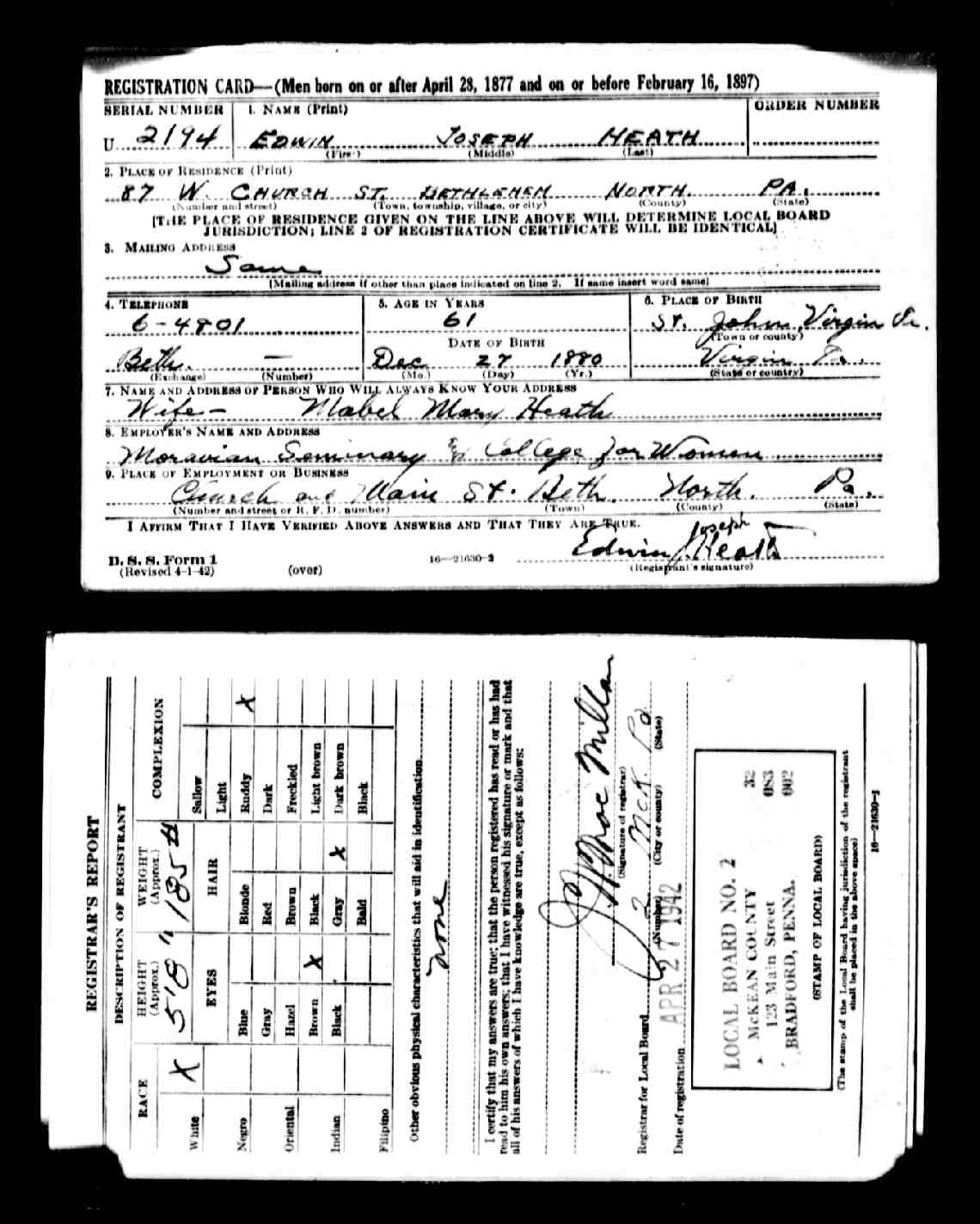
| HEATH, Edwin Joseph, clergyman, educator b. St Johns Danish West Indies Dec 27, 1880. George Octavia and Charlotte Elisabeth (Reimle) H.: wep.end Fuhecl Sch. Leeds Eng, A.B. Moravia Coll. Bethlehem, PA 1904 A.M. 1916: BD. Moravian Theol Sem. 1907 D.D. Ursinus College 1910 m. Mabel Mary Graham, Oct 17 1908, children Barbara Mary, Edwin Clifford, Marian Graham. Come to United States 1901, naturalized citizen 1924. Ordained ministry Moravian Ch. 1904. Supt. Moravian Mission, Trinidad, B.W.I 1907-11, pastor St. John's Ch. Antigua, B.W.I 1911-14, also warden, Antigua mission and dir. Teacher's training Coll. Antigua 1911-14; exec sec Salem Acad and Coll Winston-Salem 1915-26 pres. Moravian Sem. and Coll. for Women Bethlehem since 1926. Mom. Am Hist. Soc. Am. Acad. Polit and Social Science, Nat Assn Biblical Instructors, Moravian Hist. Sec. Moravian Ch Bd. of Christian Edn. Pa Coll. Pres. Assn, PiGamma Mu. Democrat Rotarian Home: 77 W. Clouch St. Bethlehem, PA |
||||||||||||||||||||||||||||||||||||||||||||||||||
| Census Record : http://www.calverley.info/cen_pud_1891_ed14.htm
|
||||||||||||||||||||||||||||||||||||||||||||||||||
| The following are memories from Marian Graham Heath Hooper, daughter of Edwin Joseph Heath, recorded October 13, 2006 : Edwin Joseph Heath was born on December 27, 1880 in St. John, US Virgin Islands, where his parents, Charlotte Reinke Heath and George Octavius Heath, were missionaries. At the time the Virgin Islands were still Danish. Charlotte Amalie (pronounced Uh-MAL-yuh) the capital of USVI, was named after the Queen of Denmark. George Octavius was so called because he was the eighth child of.....?? Whoever they were. He was one of six living children who grew to adulthood. It is said that Charlotte Heath had 12 babies, including twins, but only six survived early childhood. Edwin's five siblings were: George Reinke Heath, (oldest) Mary Heath Fraser (married James Fraser), Herbert Heath, (moved to Canada, married his cousin Blanche, had 4 children) and Harold Heath (married Janet?, became an actor, entertainer, and magician. He was a one-man band, FAR more interesting than the others. Uncle George, however, was a genius and linguist, spoke 12 languages, gave the Miskito Indians their first written grammar, also had gone to medical school in Heidelberg, Germany and knew lots of cures. Charlotte had been an American. The Reinkes came to the US from Sweden in the 17th century and she had an ancestor who had been a circuit riding preacher in Swedesboro, NJ in 1696. I'm not sure if she was a Moravian. My grandfather George O. Heath was a handsome, blue eyed, white haired guy in his photograph taken around 1920 or so. Grandma Charlotte was somewhat more severe. George's family as I understand it, were from somewhere in the midlands of England. George and Charlotte sent all their children except baby Harold to school in England, as was the custom with colonials living abroad. The missionary parents traveled around 'mishing" all over the Caribbean. My dad considered Jamaica "his" island. Some of his siblings were born there. The Heath children went to Fulneck School,, a Moravian school in Fulneck, near Leeds, in England. Judging from reports, it was a horrible place, very strict, very Dickensian. Evidently those old German Moravians had missionaried themselves over to England and converted some English families, probably in the 18th or early 19th century, so there are English Moravians, and this Heath family were some of them. After finishing Fulneck, Edwin, my dad, went to London to work for a time for the British and Foreign Bible Society. While in London he went to music halls and learned some funny patter songs, which he used to sing. He also attended the Diamond Jubilee of Queen Victoria, whenever what was, let's see, 1837 plus 60, it was in 1897. He attended it as a person standing in the street waving a flag, not at Buckingham Palace. His older brother George had gone, it is said, to Heidelberg in Germany to study medicine, but contracted tuberculosis and had to drop out, and while recovering he changed his mind and went to theological seminary in Bethlehem. Edwin followed, and graduated from Moravian College for Men in 1904. He went on to get a B.D, degree from Moravian Theological Seminary, was ordained and became a missionary, I think the boys' dad, George O, had also gone there for his degree, while there, he met this American girl he married that would be Charlotte. |
||||||||||||||||||||||||||||||||||||||||||||||||||
Early Moravians in Antigua... The Moravian presence in the West Indies was prompted by Anthony Ulrich, a slave from the Danish West Indies, who traveled in 1731 to Denmark and Germany, where he told Moravians of “the desire of blacks [in the West Indies] … for an opportunity to hear the Christian gospel” (Dayfoot 121). A year later, two members of the German Moravian colony arrived in St. Thomas. It was not until 1756, that the Moravian mission expanded to Antigua. Unlike the Moravian missionaries in the Danish islands and Jamaica, the Antigua evangelists did not support themselves by becoming planters and slave owners. “While this created [financial] hardship for the [missionary] workers themselves,” Dayfoot writes, “it relieved them of duties that were incompatible with their purpose, and it made for better relations with the slaves” (126). Moravian membership quickly multiplied at the end of the 18th century, and by 1799, it reached 11,000. Dayfoot, Arthur Charles. The Shaping of the West Indian Church: 1492-1962. Gainesville: University of Florida P, 1999. Also relative to Prince’s narrative is the Moravian requirement of personal accounts of members’ lives. “Each member of the Moravian Church was required to leave a Lebenslauf (literally, life course), a memoir or short autobiography describing a few details of the person’s outward life and an account of his or her spiritual journey. Typically the memoirs depict a sequential process leading from an unredeemed life of sin to spiritual crisis, conversion, and a new life dedicated to Christ. After the person’s death, a minister finished the memoir and read it aloud at the funeral” (Sensbach xxii). Katherine M. Faull has published the brief Lebenslauf of Magdelene Beulah Brockdon (1731-1820), who was kidnapped from the Guinea Coast as a child and sold into slavery in Philadelphia. The memoir of Magdalene’s husband, an Igbo named Ofodobendo Wooma (Andrew), appears in Daniel B. Thorp’s “Chattel with a Soul: The Autobiography of a Moravian Slave.” Another enslaved West African’s life story is preserved in the Memoir of Abraham, which was written in German by a Moravian minister in North Carolina and was “based largely on oral testimony the African Moravian had supplied before he died” (Sensbach 2). Faull, Katherine M. Moravian Women’s Memoirs: Their Related Lives, 1750-1820. Syracuse: Syracuse University P, 1997. Sensbach, Jon F. A Separate Canann: The Making of an Afro-Moravian World in North Carolina, 1763-1840. Chapel Hill: University of North Carolina P, 1998. History Moravian traces its origin to a girls' school founded in May 1742 by sixteen-year-old Countess Benigna von Zinzendorf. The young countess, on an eighteen-month visit to the Moravian settlements in the New World with her father, Count Nicholas von Zinzendorf, was following a Moravian tradition that was already old in her time. The roots of the Moravian denomination go back to the Bohemian Protestant martyr John Hus, who died at the stake in 1415. In 1457 the denomination was formally organized under the name Unitas Fratrum, "the Unity of the Brethren." The Brethren (later called the Moravians in the New World) gave to the world the pioneer educator John Amos Comenius (1592-1670), who was one of their bishops. Called "the father of modern education" for his revolutionary educational principles, Comenius was a man of his time in thinking of education in religious terms. He viewed education as an instrument of salvation (because the soul had to be trained to search for truth and to recognize it when it was found). Since the Moravians considered every human soul a potential candidate for salvation, every human being had to be educated. Comenius wrote in 1632 that "not the children of the rich or of the powerful only, but of all alike, boys and girls, both noble and ignoble, rich and poor, in all cities and towns, villages and hamlets, should be sent to school." The Moravians therefore considered schools secondary in importance only to churches. Following a period of intense persecution, during which the struggling church was threatened with extinction, the Brethren in 1722 were given asylum on the Saxony estate of an ecumenical-minded Lutheran nobleman, Count Nicholas von Zinzendorf, who became their leader as well as their benefactor. In 1732 settlers from Germany and Moravia (now part of the Czech Republic) came to the New World. On Christmas Eve 1741 they founded the community of Bethlehem in what was then wilderness, sixty miles north of Philadelphia. Count Nicholas and his daughter were there for the occasion. Benigna von Zinzendorf's school was the first girls' boarding school in America. It gained such a distinguished reputation that George Washington, during his second term as president of the United States, personally petitioned the headmaster for the admission of two of his great-nieces. The Bethlehem Female Seminary, as the school became known, was chartered to grant baccalaureate degrees in 1863, and in 1913 became Moravian Seminary and College for Women. A boys' school was established in Bethlehem in July 1742, and another in nearby Nazareth in 1743. These schools merged in 1759 to form Nazareth Hall, an institution which survived until 1929. In 1807 a men's college and theological seminary was established as an extension of Nazareth Hall. That institution, Moravian College and Theological Seminary, moved to Bethlehem in 1858 and was chartered to grant baccalaureate degrees in 1863, the same year as the women's college. In 1954, after two centuries of separate development and growth, the women's and the men's institutions were combined to form a single coeducational college. Moravian Theological Seminary maintained a closely related but academically distinct identity as a graduate school of theology. As a result of the merger, Moravian College became the Lehigh Valley's first coeducational institution of higher education. |
||||||||||||||||||||||||||||||||||||||||||||||||||
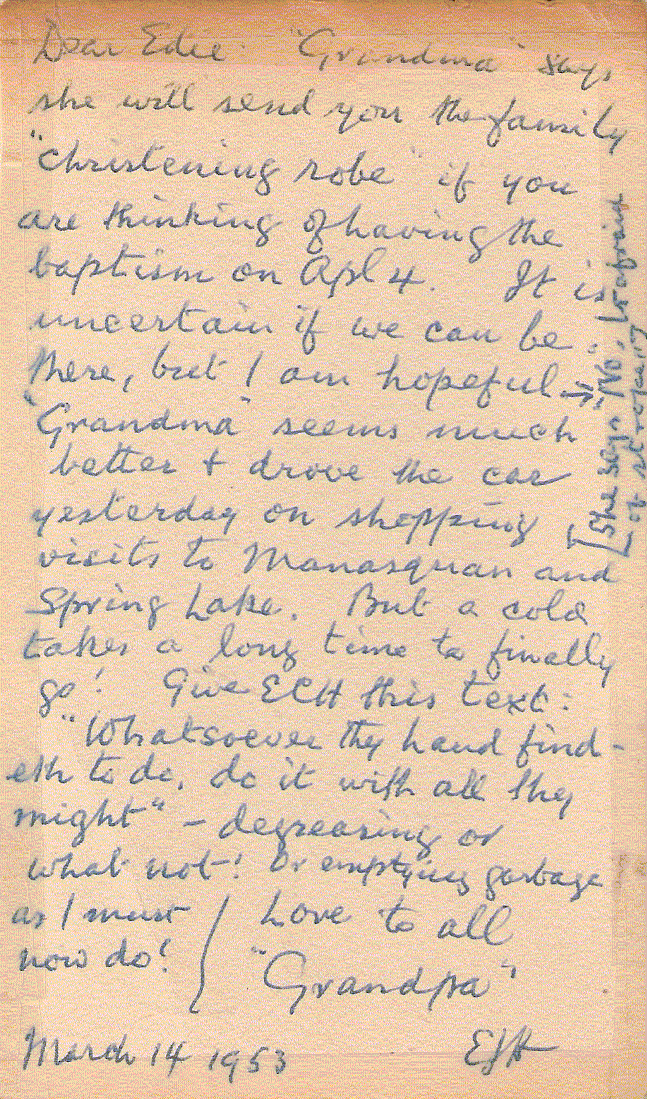
| Note from Edwin J. Heath March 14, 1953 - to Edie (Daugue Heath) (Ed Note : wife of Edwin Clifford Heath) - "Grandma" says she will send you the family "christening robe" if you are thinking of having baptism on Apr 4 (Ed. Note : This would have been the baptism of Patti Jane Heath, who was born in Dec of 1952). It is uncertain if we can be there, but I am hopeful. (She says "No" to afraid of stroke). "Grandma" seems much better & drove the car yesterday on shopping visits to Manasquan and Spring Lake. But a cold takes a long time to finally go! "Whatsoever they hand find elk to do, do it with all thy might" - displeasing or what not! Or emptying garbage as I must now do! Love to all.. "Grandpa". EJK March 14, 1953. |